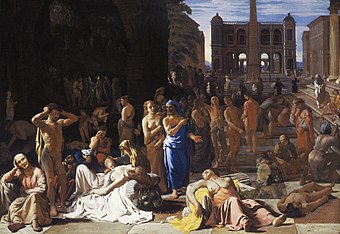
The Plague of Athens (Ancient Greek: Λοιμός τῶν Ἀθηνῶν Loimos tôn Athênôn) was an epidemic that devastated the city-state of Athens in ancient Greece during the second year of the Peloponnesian War (430 BC) when an Athenian victory still seemed within reach. The plague killed an estimated 75,000 to 100,000 people and is believed to have entered Athens main city through Piraeus, the city’s port and sole source of food and supplies. Much of the eastern Mediterranean also saw an outbreak of the disease, albeit with less impact. The plague had serious effects on Athens’ society, resulting in a lack of adherence to laws and religious belief; in response laws became stricter, resulting in the punishment of non-citizens claiming to be Athenian. The plague returned twice more, in 429 BC and in the winter of 427/426 BC. Some 30 pathogens have been suggested as causing the plague.
Η Ιστορια ειναι μεγαλη Που….!!
· Κατοχικά Νέα
ΜΗ ΦΥΓΕΙΣ ΑΚΟΜΑ
Τρία σχετικά θέματα που αξίζει να δεις
 FEATURED
Στάσεις εργασίας στις εφορίες: Πανελλαδικό πρόγραμμα κινητοποιήσεων έως την απεργία της 25ης Νοεμβρίου
 FEATURED
ΕΦΚΑ και ΔΥΠΑ: 71,78 εκατ. ευρώ σε 83.420 δικαιούχους από 19 έως 23 Οκτωβρίου – Όλες οι πληρωμές
 FEATURED
..και γινεται μεγαλητερη αν μπλεξει με επαγγελματιες ματροπους